


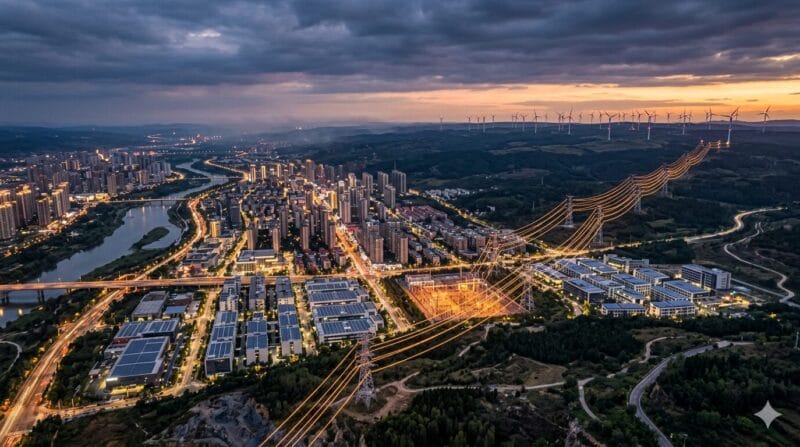
Tech & Society · Earth Week 2026
Earth Week 2026 has a theme: “Our Power, Our Planet.” It sounds inspiring. However, the actual work of making it real is less photogenic. It happens in substations, server rooms, and regulatory hearings. Here is what smart grids 2026 are about, why they matter from California to South Africa, and how to tell real progress from a clean energy press release.
The problem nobody posts about during Earth Week
Every April, the conversation about clean energy focuses on the visible things. Solar panels. Electric vehicles. Wind farms. These are real and important. However, they all depend on something less visible to work: a power grid that can actually handle them.
Most of the world runs on grids designed decades ago. They were built for electricity to flow in one direction. Power moved from a handful of large coal or gas plants out to homes and businesses. Now, we are adding millions of solar panels, batteries, and electric vehicles to that system.
Think of it this way. It is like trying to route two-way traffic down a one-way road. The road has to change, not just the cars.
That is what smart grids are about. They are not a single product or technology. Instead, they are a fundamental upgrade to how power networks are built, monitored, and managed. As a result, smart grids 2026 sit at the center of one of the most consequential infrastructure projects on earth.
What a smart grid actually does
The term gets used loosely, so here is the plain version. A smart grid adds a digital layer to the existing network of wires, transformers, and substations. Smart meters, sensors, and automated switches feed real-time data into control centers. Then, software uses that data to spot problems faster, reroute power when something fails, and plan upgrades based on actual usage.
This digital layer makes a huge difference. For example, it allows grids to handle millions of small generators like rooftop solar panels and home batteries. Before this upgrade, grids could only manage a few central plants.
The digital layer also enables newer models. Virtual power plants are one example. With these, a utility groups together thousands of batteries or flexible industrial loads across a whole region. Then it treats them as one resource. Local micro-grids are another example. These can run independently when the main network fails during storms or extreme heat.
Without this infrastructure upgrade, clean energy targets are not achievable in most countries. According to the IEA’s Electricity 2026 report, more than 2,500 gigawatts of projects are currently stalled in connection queues worldwide. In Europe alone, around 1,700 gigawatts of renewable projects are stuck across 16 countries. Meanwhile, the United States queue has reached 2,600 gigawatts. That is more than twice the entire installed capacity of the US power system.
The global numbers, honestly
Grid investment is moving at a scale that does not get much Earth Week attention. According to BloombergNEF’s Grid Investment Outlook from December 2025, global grid spending exceeded 470 billion dollars in 2025. This was the first time it crossed that threshold.
The United States led with 115 billion dollars, about a quarter of the global total. China and the EU followed, each at roughly 20 percent.
Smart grid coverage is also expanding fast. Research from Juniper Research, published in September 2025, found that smart grids underpinned less than 25 percent of global electricity distribution in 2024. By 2030, this is projected to reach 42.7 percent.
The smart meter rollout tells a similar story. By the end of 2024, the global installed base of smart meters surpassed 1.8 billion units. By 2030, it is projected to cross 3 billion, according to Counterpoint Research. North America already sits at around 81 percent penetration. The strongest growth opportunities are in Latin America, Africa, and South Asia.
The flexibility question is just as urgent. The IEA has warned that electricity system flexibility needs to more than double by 2030 to keep climate goals within reach. In simple terms, this means the ability to balance supply and demand hour by hour. Smart grids are the mechanism that makes this flexibility possible.
Finally, McKinsey’s Global Energy Perspective 2025 projects renewables could grow to 61 to 67 percent of global electricity by 2050. The pathway depends entirely on grids being upgraded fast enough.
How different regions are approaching it
There is no single model. Each region is trying to solve the same physics problem with different money, politics, and starting points.
| Region | What is happening | Honest trade-offs |
|---|---|---|
| North America | The US led global grid investment in 2025 at 115 billion dollars. Large utilities are rolling out smart meters and demand-response programs. Data center growth is driving new electricity demand at unprecedented speed. | Ageing infrastructure and long permitting timelines are slowing projects. The US grid queue has reached 2,600 gigawatts. Median wait times approach five years, and over 70 percent of requests are eventually withdrawn. |
| Europe and the UK | The EU released its European Grids Package in December 2025 to clear connection bottlenecks. Some countries are already on second-generation smart meter rollouts. The EU Energy Efficiency Directive mandates 80 percent smart meter installation by 2030. | Around 1,700 gigawatts of renewable projects are stuck across 16 countries. That is more than three times what the EU needs for 2030 climate targets. Over 40 percent of EU distribution grids are more than 40 years old. |
| East Asia | Heavy investment in ultra-high-voltage transmission lines. China alone has installed over 500 million smart electricity meters, the largest national rollout in the world. | Rapid build-out raises questions about overcapacity in some provinces. There are also cybersecurity concerns at scale and questions about whether regulations can keep pace with the technology. |
| Emerging markets | Hybrid strategies mix central-grid upgrades with solar mini-grids and distributed charging. India is targeting 250 million prepaid smart meters under its Revamped Distribution Sector Scheme. | Limited public budgets and currency volatility slow expansion. Many communities still depend on diesel for backup power. Grid reliability remains inconsistent in parts of all three regions. |
The practical point is encouraging. Emerging markets have a real opportunity to build more resilient, more distributed systems. As a result, they can avoid inheriting the full legacy debt of older grids. TechCity has covered the electric vehicle landscape in emerging markets, and the grid question sits underneath all of it. Cleaner transport only works if the electricity powering it is also getting cleaner.
The data center pressure is real, and growing
One of the biggest forces reshaping global grids in 2026 is the demand from data centers. AI workloads are driving most of this growth. According to IEA figures from April 2025, data centers consumed roughly 415 terawatt hours of electricity in 2024. That was about 1.5 percent of global consumption.
By 2030, this is projected to roughly double to 945 terawatt hours. To put that in perspective, that is equivalent to Japan’s entire current annual electricity use.
The pace is faster than most projections suggested. The IEA reported in April 2026 that data center electricity demand grew by 17 percent in 2025 alone. AI-focused facilities grew even faster. In addition, capital expenditure by the five largest tech companies surged past 400 billion dollars in 2025. It is expected to grow another 75 percent in 2026.
This matters for grids in two ways. First, data centers create large, concentrated power loads in specific regions. Therefore, they can stress local networks faster than utilities can upgrade them. For example, Ireland already uses around 22 percent of its national electricity for data centers. The IEA projects this could reach 32 percent by 2026.
Second, when grid connections are too slow, data center developers turn to onsite gas-fired generation. As a result, the broader transition to cleaner power slows down.
What this looks like in daily life
For most people, a smarter grid does not arrive as a dramatic announcement. Instead, it shows up in smaller, practical changes.
Time-of-use pricing is becoming more common in markets where smart meters are deployed. Power costs less during off-peak hours, typically overnight or midday when solar output is high. It costs more during evening peaks. As a result, you have a real incentive to run the washing machine or charge an electric vehicle at a different time. This takes pressure off the grid exactly when it needs it most.
Usage visibility changes behavior. Customers with smart meters can see their electricity consumption by hour, not just as a monthly total. In some markets, utilities run programs that pay households and businesses to reduce demand during critical periods. That is not just a utility tool. It is money back for participation.
Resilience during extreme events is where smart grids and micro-grids make the most immediate difference. In regions dealing with more frequent storms, wildfires, or heatwaves, local systems can separate from a failing main grid. As a result, hospitals, water treatment plants, and community centers stay running when the broader network goes down. Globally, grid outages already cost around 100 billion dollars a year in lost economic activity, according to the IEA.
For younger readers building careers, the intersection of software, climate, and physical infrastructure is one of the more durable skill areas in tech right now. Grid analytics and energy market tools are growing fields. For readers who remember a simpler relationship with a utility company, the practical questions are straightforward. What does your new meter actually do? Why might your prices vary by time of day? And how do you enroll in programs that pay you to shift your demand?
Where the money and innovation are going
A few trends are worth watching closely in 2026. They represent where the sector is moving beyond pilots into scale.
Virtual power plants are one of the more significant developments. Companies in the United States, Australia, and parts of Europe now aggregate thousands of home batteries, electric vehicles, and commercial loads into a single flexible resource. Then they bid that resource into wholesale electricity markets. Juniper Research identified virtual power plants as a key growth driver for the smart grid market through 2030. For participants, it means their battery earns money while sitting idle. For the grid, it means flexible capacity without building a new gas plant.
AI-driven grid operations are already in use, but the type matters. Traditional machine learning models are quietly delivering real operational improvements. They forecast renewable output, detect equipment faults early, and optimize how power is dispatched. Their energy cost is relatively low.
However, these are not the same as the large generative AI systems driving data center expansion. The useful work is quieter and less heavily marketed. TechCity has covered that distinction. Bundling energy-hungry generative AI with lower-impact operational tools and calling the whole package a climate solution is one of the more common forms of greenwashing in 2026.
EV and building integration is moving from concept to regulation in several markets. If millions of electric vehicles charge every evening, that is either a grid stress point or a grid asset. The difference depends on whether the charging is smart. By pairing EV networks with grid controls, the load can be shifted, smoothed, or even fed back to the grid at peak moments. BloombergNEF’s 2025 outlook identified EV charging as one of the largest drivers of grid investment over the next two decades.
How to tell real grid progress from green marketing
Earth Week is prime season for utilities and tech companies to announce smart grid investments. Some of those announcements describe real work. Others are dashboards without infrastructure behind them.
First, ask whether there is measurable improvement in the things that matter. Look for outage duration and frequency, how much renewable energy is being curtailed, and how much fossil fuel is still needed during peak demand. If a company cannot answer those questions with numbers, their smart grid language is probably more marketing than engineering.
Second, ask whether customers can actually participate. Demand response programs only work if households and businesses can enroll, understand the rules, and see the benefit on their bills. Programs that exist only on paper, or only for large industrial customers, are not a smart grid story yet.
Finally, ask about transparency. Are annual reports published showing grid investment, renewable integration, and emissions performance? Is that data independently verified, or self-reported? The same standard TechCity applied to AI climate claims applies here. “100% renewable” and “smart grid” are both phrases that need receipts.
Three questions to ask any utility or tech company this Earth Week:
- When you say “smart grid,” what specific improvement in outage time or peak fossil use can you show from the past 12 months?
- Can ordinary customers join a demand response program, and what do they receive in return?
- Is your renewable energy claim based on actual hourly matching near your facilities, or on paper certificates?
What policymakers and tech companies need to do differently
The path forward is not mysterious. The obstacles are mostly political and financial, not technical.
First, regulators need long-term grid plans. These should treat electric vehicles, rooftop solar, data centers, and extreme weather as baseline assumptions, not edge cases. The IEA estimates that planning, permitting, and completing new grid infrastructure can take five to 15 years. By contrast, renewable energy projects are typically delivered in one to five years. That gap is the bottleneck.
Next, flexibility markets need to be opened to smaller participants. The economic logic of demand response only spreads if households and small businesses can enroll as easily as large industrial customers. Where those markets are open, the evidence shows they work.
In addition, tech companies expanding cloud and AI infrastructure globally need to treat grid impact as a product design question. That means co-investing in new renewable capacity near where their data centers actually sit, not just buying certificates. It also means aligning expansion plans with grid capacity rather than racing ahead of it.
Finally, cybersecurity cannot be an afterthought. Over 1.8 billion smart meters are already deployed, with another 1.2 billion expected by 2030. Therefore, the attack surface is significant. The IEA reported that AI-enabled cyberattacks on utilities have tripled over the past four years. The laws and standards governing this need to be built before the first major breach, not after.
The honest summary for Earth Week 2026
The theme “Our Power, Our Planet” is genuinely apt. Power infrastructure is where climate commitments get tested against reality. It is also where the math on emissions either works or does not.
Smart grids are not a silver bullet. Instead, they are an enabling condition. They are the infrastructure layer without which solar, wind, batteries, and electric vehicles cannot reach their potential. The investment is moving in the right direction at a global scale. However, the pace is not yet matching the urgency.
The most useful thing Earth Week can do is push that conversation past logos and campaigns. It needs to move into the regulatory meetings, utility boardrooms, and policy hearings where grid decisions are actually made. That is less photogenic than a tree-planting post. It is also where the outcome is decided.
Related reading on TechCity
- Earth Week 2026: Sustainable Tech Worth Supporting, and the Brands Just Greenwashing
- Africa’s Data Centre Ambition: The Transmission Problem Nobody Talks About
- The Future of Electric Vehicles in Emerging Markets
- 5 Ways AI Is Helping Governments and Businesses Become More Sustainable
- The E-Waste Crisis Nobody Wants to Talk About
Frequently Asked Questions
What is a smart grid and how is it different from a regular power grid?
A regular power grid moves electricity in one direction. Power flows from large central plants to homes and businesses. A smart grid adds sensors, software, and two-way communication across the network. As a result, grid operators can manage millions of small generators like rooftop solar panels. They can also respond to problems in real time and let customers shift when they use power. According to Juniper Research, smart grids 2026 are projected to underpin 42.7 percent of global electricity distribution by 2030, up from less than 25 percent in 2024.
Why does grid investment matter for clean energy goals?
Renewable energy only works if the grid can absorb, store, and distribute what solar and wind farms generate. As of early 2026, more than 2,500 gigawatts of projects are stalled in connection queues globally. Around 1,700 gigawatts are stuck in Europe and 2,600 gigawatts in the United States. Building more renewable capacity without upgrading the grid is like adding more cars to a road system that cannot expand.
How can I tell if a company’s smart grid claim is genuine?
Ask three things. First, can they show measurable improvement in outage duration, renewable curtailment, or peak fossil fuel use? Second, can ordinary customers join demand response programs and see a benefit on their bill? Third, is the renewable energy claim based on actual hourly power matching, or on paper certificates? If none of those questions get a clear answer, treat the claim with skepticism.
What does a smart grid mean for someone at home?
Time-of-use pricing means your electricity may cost less at certain hours. As a result, you can save money by shifting tasks like laundry or EV charging to those windows. A smart meter gives you hour-by-hour usage data rather than just a monthly total. In addition, in areas prone to outages, local micro-grids can keep essential services running when the main network fails. By the end of 2024, more than 1.8 billion smart meters were already installed worldwide.


