


If you’ve been watching AI transform work and wondering whether it can really help with content, the short answer is yes, but only if you use it the right way. The best results do not come from asking a tool to do everything for you. They come from using AI to speed up the boring parts, sharpen your ideas, and help you publish more consistently.
That is where how to use ai for content creation becomes less of a buzzword and more of a practical skill. Whether you are a solo founder, a marketer, a creator, or a newsroom team, AI can help you research, outline, draft, repurpose, and optimize content without losing your voice.
What AI Can Actually Do For Content Teams
AI is strongest when it helps with structure and speed. It can brainstorm headlines, suggest content angles, turn rough notes into an outline, summarize research, and adapt one article into multiple formats. It is also useful for editing, especially when you need cleaner grammar, tighter phrasing, or a quicker first draft.
Here’s the thing, AI is not a replacement for judgment. It cannot know your audience as well as you do, and it should not be trusted blindly on facts, tone, or brand positioning.
Best use cases for AI
- Idea generation for blogs, newsletters, scripts, and social posts
- First-draft writing for routine content
- Repurposing long-form content into shorter formats
- SEO support, such as title ideas and keyword variations
- Content editing, rewriting, and tone adjustment
Start With Strategy, Not Prompts
The biggest mistake people make is jumping straight into prompting. If you do not know who the content is for, what action it should drive, or what problem it solves, AI will only produce generic output.
Before you write anything, define three things:
- Audience: Who is this for?
- Goal: What should the content achieve?
- Angle: Why should anyone care right now?
For example, a founder in Lagos may need a blog post that explains how AI improves customer support. A media brand might need a fast, accurate explainer on an AI product launch. A small business might need social captions that drive clicks and trust. The prompt changes, but the strategy comes first.
Build Better Prompts For Better Output
Good prompts are specific. They tell the tool what to write, who it is for, how it should sound, and what success looks like. If you want content that feels human, you need to guide the AI like a smart assistant, not a magic wand.
A strong prompt usually includes:
- Topic and target audience
- Tone and brand voice
- Format and length
- Key points to include
- Keywords or sources to reference
- What to avoid
Example prompt structure
Write a 900-word blog post for SME founders in Africa about using AI for content marketing. Keep the tone authoritative but accessible. Include an introduction, 4 main sections, a conclusion, and practical examples. Avoid jargon, and make the advice action-oriented.
That one prompt will usually outperform five vague ones.
Use AI Across the Full Content Workflow
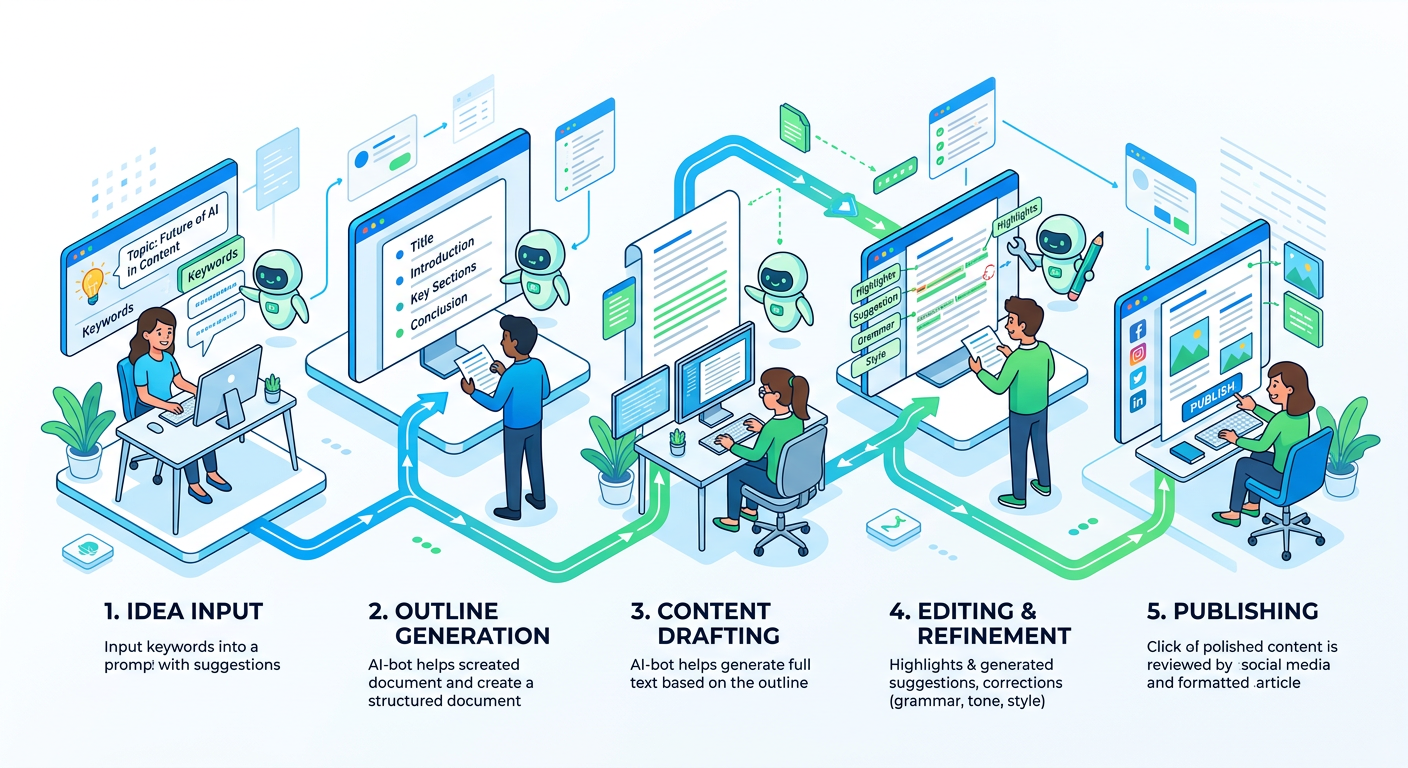
If you only use AI to write drafts, you are leaving value on the table. The smartest teams use it across the whole process, from planning to publishing.
1. Research faster
AI can help you collect topic angles, summarize background material, and identify common questions readers ask. You still need to verify facts with reliable sources, but it can cut research time dramatically.
2. Outline before drafting
A clear outline keeps content focused. Ask AI to build a section-by-section structure, then edit that structure before drafting begins. This reduces rambling and helps you control the narrative.
3. Draft with human oversight
Let AI generate a first version, then rewrite it in your own voice. Add examples, local context, statistics, and opinions that make the piece feel grounded and credible.
4. Edit ruthlessly
Use AI to tighten sentences, fix awkward transitions, and improve readability. But always do a final human edit for accuracy, clarity, and tone.
5. Repurpose strategically
One article can become a LinkedIn post, a newsletter summary, a video script, an email teaser, or a social carousel. AI is especially useful here because repurposing is repetitive but high value.
Keep Your Voice Human
AI-generated content often sounds polished but flat. The fix is simple, add specific details only you would know. Mention customer pain points, local examples, behind-the-scenes context, and opinionated takeaways. That is where your brand voice comes alive.
You can also train consistency by creating a style guide for AI use. Include preferred tone, banned phrases, audience priorities, and examples of strong past content. The more context you give, the less generic the output becomes.
Watch Out For Common Mistakes
AI is powerful, but it creates new risks if you use it carelessly.
Common problems to avoid
- Publishing factually incorrect content without verification
- Letting AI write in a bland, robotic tone
- Overusing the same structure across every post
- Ignoring SEO and reader intent
- Using AI-generated content without human review
A good rule is simple, if the content affects trust, money, health, law, or reputation, a human must review it.
How AI Helps Different Types Of Creators
Different teams get different benefits from AI.
For marketers
AI helps you scale campaigns, test headlines, and create content variations faster.
For founders
It saves time on thought leadership, product updates, pitch content, and customer education.
For media and publishers
It supports research, summarization, internal workflows, and multi-format distribution.
For SMEs
It reduces the cost of producing consistent content when you do not have a large in-house team.
Make AI Work With Your Content Goals
The best approach is not to ask whether AI should create your content. It is to ask where AI creates leverage. If it saves time on routine tasks, improves consistency, or helps your team publish more often, it is doing its job.
Used well, how to use ai for content creation is really about building a smarter editorial process, not replacing creativity. The winning formula is simple, let AI handle speed, while you handle judgment, originality, and trust.
Keep Learning And Experimenting
AI tools change quickly, so your workflow should too. Test different prompts, compare outputs, and track what actually improves performance. The teams that benefit most are the ones that treat AI as an evolving assistant, not a one-time shortcut.
If you work across global markets, especially in fast-moving ecosystems like Nigeria, Africa, the UK, and the US, AI can help you stay nimble without sacrificing quality. That combination, speed plus editorial standards, is where the real advantage lives.
Grow Smarter With TechCity
If you want more practical guides, sharp analysis, and global tech context that helps you move faster, keep reading TechCity. We cover the tools, trends, and market shifts shaping the future of business and technology across Africa and beyond.
Visit TechCity for more insights, tutorials, and technology news that help you stay ahead.
Final Thoughts
AI is not here to replace good content, it is here to make good content easier to produce at scale. When you pair the right tools with strong strategy, human editing, and a clear point of view, you can create faster without sounding generic.
That is the real advantage of learning how to use ai for content creation. It is not just about productivity. It is about building a content engine that is faster, sharper, and far more consistent than what most teams can do manually.


