


Every April, tech companies go green. The graphics change. The press releases land. Then May arrives, and nothing much does. Here is a plain-language guide to figuring out who is doing real work on sustainable tech in 2026, and who is running a cleanup operation on their image.
The noise is loud. The numbers are louder.
This is Earth Week 2026, and your social feeds are filling up with eco campaigns, tree-planting promises, and limited “green” editions of products that are not especially green. Companies are calling AI a climate solution. Some are claiming their operations run entirely on renewable energy.
None of that is automatically true, and some of it is demonstrably false.
Here are the numbers behind the noise. Data centers, the server warehouses that power every app, AI chatbot, and streaming service you use, consumed about 4.6 percent of total US electricity in 2024. That share could nearly triple by 2028, according to US government estimates. A January 2026 study in the journal Patterns put data center carbon emissions between 32.6 million and 79.7 million tonnes of CO2 for 2025 alone. That is roughly equivalent to the annual emissions of a small European country.
Meanwhile, the companies building these data centers have seen their own emissions climb sharply. Google’s emissions rose nearly 50 percent over the past five years. Amazon’s went up 33 percent. Meta’s increased by more than 60 percent. These are figures drawn directly from their own sustainability reports.
So when a tech brand posts a green logo this week, the fair question is not whether they mean well. The question is what the actual numbers say.
The two real problems: e-waste and energy
Most Earth Week tech coverage focuses on packaging. Recycled cardboard, paper tape, plastic-free boxes. That stuff matters, but it is not where the impact is.
The two biggest problems are e-waste and energy, and they work very differently.
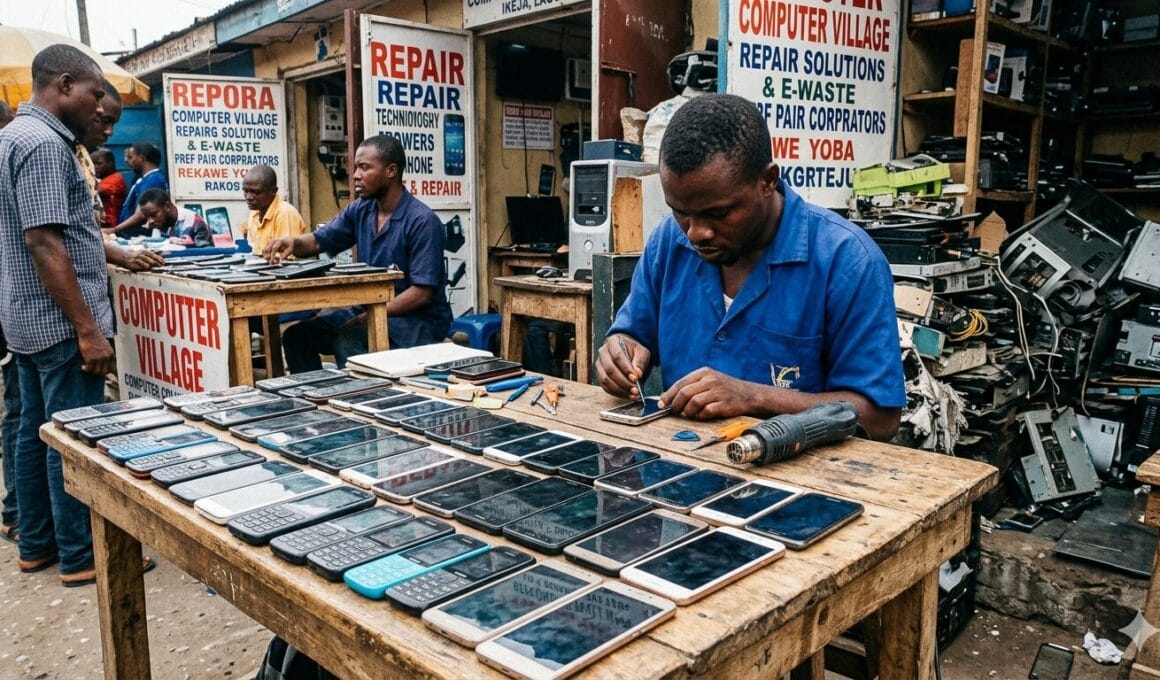
E-waste is the physical wreckage of tech culture: old phones, dead chargers, cracked tablets, tangled cables, and the batteries inside all of them. These devices contain lead, mercury, and lithium, which can poison soil, water, and communities when they end up in informal dumps or unregulated recycling sites. TechCity has covered how this crisis plays out on the ground, including in markets like Alaba International Market and Computer Village in Lagos, where repair culture extends device life but informal recycling remains a real hazard.
Energy consumption is the less visible problem. Every search, every AI prompt, and every video stream routes through a data center that uses enormous amounts of electricity and water to keep its servers running. Africa’s data center boom adds to this picture: more capacity brings more opportunity, and it also brings more demand on power grids that still rely heavily on fossil fuels.
Keep both of these in mind as you read any company’s Earth Week claims. Sustainability in tech is not a packaging redesign. It is a reckoning with both problems at once.
A four-question test you can run on any brand
Before naming companies or products, here is a simple checklist. Apply it to any device you are thinking about buying, or any brand campaign you see this week.
1. Can you repair it, or are you expected to replace it?
A device that can be repaired lasts longer, which means less waste. Look for companies that sell their own spare parts, publish repair guides, or openly support independent repair shops. Be cautious of sealed batteries with no practical replacement path, glued components with no structural reason to be glued, and warranty policies that punish you for going to a third-party repair shop. Calling something “sustainable” while making repair expensive or impossible is greenwashing at the product level.
2. What happens to the device when you are done with it?
Every phone and laptop has an end of life. The question is where it goes. Good signs include trade-in and take-back programs that connect devices to certified recyclers, and clear information about drop-off points. A bad sign is a company that ships millions of units, says nothing about safe end-of-life handling, and simply tells users to “check with your local authorities.”
This is where most brands fall apart. Look for specific data: what percentage of their devices contain recycled materials, what energy mix powers their data centers, what their emissions targets are, and whether those targets are being independently verified. Vague language like “eco-friendly,” “carbon neutral,” or “100% renewable” with no explanation of how they arrived at those figures is not a data point. It is a design choice.
4. Is sustainability baked into the product, or only the press release?
Real change shows up in things you can touch. Longer software update commitments mean a phone stays usable for more years. Accessible repair means you can fix a broken screen without buying a new device. Investment in genuinely new renewable energy infrastructure near where data centers actually sit means the server answering your AI query is not powered by a gas plant. If a company’s sustainability story only appears in April and vanishes by May, it is telling you something.
What is worth paying attention to in 2026
No tech company is a perfect environmental actor. The more honest question is who is moving in a direction that is actually verifiable.
Hardware makers that are at least asking the right questions
Some smartphone manufacturers are building recycled plastics and metals into their flagship devices and committing to longer software support cycles. Samsung’s Galaxy S25 series, for example, includes components made from recycled materials and the company has made public commitments around carbon reduction in its manufacturing process. That does not cancel out the environmental cost of shipping tens of millions of new devices every year, but it is a measurable step in the right direction, and it gives you something to verify. When shopping, check: how many years of security updates are promised, whether the battery is replaceable in any practical sense, and whether the company makes its sustainability data publicly available beyond just the launch week announcement.
African electric mobility that treats infrastructure as part of the deal
Electric vehicles mean very little without somewhere to charge them. Jet Motor Company’s JET EV, a locally designed electric van aimed at logistics and commercial transport in Nigeria, is a case where the product and the infrastructure question are being addressed together. Fewer diesel vans means less exhaust in urban centers. The trade-offs are real: upfront costs remain high, grid reliability is still a live issue, and the long-term plan for battery recycling needs more public detail. But a company that builds the infrastructure question into the product model is doing something more honest than one that sells an EV and walks away.
AI used for things it is actually good at
AI is not the problem or the solution. It depends entirely on what you are using it for. The more promising climate applications involve traditional machine learning tools, not the large generative models most people now associate with “AI.” These include forecasting wind and solar output to make renewable energy more reliable, predicting flooding and heat stress to help cities plan ahead, and tracking deforestation and illegal mining in near-real time. These use cases are real, and their energy footprint is significantly lower than the large language models that dominate the headlines. The problem is when companies bundle these useful, lower-impact tools with their most power-hungry products and sell the whole package as one climate solution. It is not.
Snapshot: who is trying, where the gaps are
| Type of tech or brand behavior | What they are doing right | Honest trade-offs |
|---|---|---|
| Smartphone makers adding recycled materials and longer software support | Recycled metals and plastics in devices, better software longevity keeps phones useful for more years | Still push annual upgrades, repair remains difficult on many models, support commitments are not equal across all markets |
| African EV makers like Jet Motor Company pairing vehicles with charging networks | Tackles local air quality, builds infrastructure alongside the product, reduces diesel dependency in commercial fleets | Grid still relies on fossil fuels in many areas, EV prices out of reach for most users, battery end-of-life plan needs more detail |
| Traditional machine learning tools applied to climate and energy | Helps forecast renewables, optimizes city planning, supports disaster response with much lower energy cost than generative AI | Small share of total AI activity, often bundled with energy-hungry generative AI in company climate narratives |
| Repair and reuse markets for used devices | Extend device lifespans, make tech more affordable, reduce the number of devices dumped in the first place | Informal recycling can still expose workers to toxic materials when devices are dismantled without proper safety equipment |
What greenwashing actually looks like in 2026
This is the part that matters most this week, because the campaigns are running right now.
AI marketed as a “planet-saver” with no receipts
In February 2026, a coalition of environmental organizations including Beyond Fossil Fuels, Friends of the Earth US, and Stand.earth published an analysis of more than 150 climate-related claims from the world’s biggest AI companies. The findings were stark.
74 percent of industry claims about AI’s climate benefits were unproven. Only 26 percent cited published academic research. 36 percent cited no evidence at all. And the analysis found no single example where a consumer generative AI system, such as ChatGPT, Gemini, or Copilot, was delivering material, verifiable emissions reductions.
The trick, as report author Ketan Joshi described it, is lumping two very different things together. Low-energy traditional machine learning tools (the kind used to forecast wind patterns or optimize bus routes) get bundled with high-energy generative AI chatbots, and the whole package gets sold as a climate solution. It is not. One part of it sometimes helps. The other part is actively making things worse, and the numbers from companies’ own reports confirm it.
“It appears tech companies are using vagueness about what happens within energy-hogging data centres to greenwash a planet-wrecking expansion.” — Ketan Joshi, climate and energy analyst
“100% renewable” claims that are mostly paperwork
Several major tech companies have told investors and users that their operations run on 100 percent renewable energy. The fine print usually involves buying renewable energy certificates, which are not the same thing as matching your actual hour-by-hour electricity use with clean power sourced near your actual data centers.
A group of US state attorneys general has already challenged some of these claims, arguing that certificate purchases do not necessarily cause more clean energy to exist. If the wind farm would have been built regardless, buying a certificate did not change the grid. It moved money. That is better than doing nothing. It is not the same as what “100% renewable” implies.
When you see that claim, ask: do they publish hour-by-hour or location-specific energy data? Are they investing in new renewable projects near where their servers actually sit? Do they acknowledge the fossil plants still backing up their operations when the sun is not shining?
Seasonal sustainability that ignores the product itself
The last type of greenwashing is the one you will see the most this week: Earth Week campaigns from brands whose core product strategy has not changed at all. One-day e-waste drives, discounted “eco” accessories, green wallpapers, and tree-planting partnerships sit alongside business models still built on annual upgrades and hard-to-repair devices. They almost never mention how long they will support the device with updates, how easy it is to replace the battery, or what actually happens to the phone after a trade-in.
A week of green content does not make up for 51 weeks of the opposite. That math is not complicated.
What you can actually do, whether you are 16 or 66
You cannot fix big tech’s emissions by yourself. But you have more power than it sometimes feels like.
Keep what you have, longer. The most sustainable device is the one you already own. If your current phone or laptop still does what you need it to do, ignore the upgrade hype. This applies equally to a teenager saving for a first phone and a retiree with a laptop that still runs fine.
When you do buy, check these three things: How many years of software and security updates is the company committing to? Can the battery be replaced practically? Does the company offer a take-back or trade-in path that leads to certified recycling rather than a landfill?
Ask the uncomfortable questions in public. When you see an Earth Week post from a tech company, look for evidence (links to third-party audits or academic research), scope (does this project cover 1 percent of their operations or 80 percent?), and limits (do they admit what they still need to fix?). Brands monitor their comment sections. A polite, specific question gets read.
Use e-waste drop-offs when they exist. Earth Week often brings pop-up collection events in both Lagos and Atlanta. Use them. If your device still works, local repair or refurbish businesses extend its life further and keep it out of the waste stream longer. Just push for safer practices in informal recycling when you can: the workers handling these devices deserve the same protection as any other worker.
Earth Week is one week. The choices that actually move the needle are the ones made across the other 51.
Stay informed beyond the campaign season. Subscribe to the TechCity newsletter for weekly coverage that goes past the press releases, including our ongoing reporting on e-waste, African tech infrastructure, and the real cost of AI. Sign up at techcityng.com
- The E-Waste Crisis Nobody Wants to Talk About
- 5 Ways AI Is Helping Governments and Businesses Become More Sustainable
- Africa’s Data Centre Ambition: The Transmission Problem Nobody Talks About
- Meet the JET EV: Nigeria’s First Electric-Powered Van
- Samsung Galaxy S25 Series: A Closer Look
Frequently Asked Questions
What is greenwashing in tech?
Greenwashing is when a tech company makes environmental claims, such as “carbon neutral” or “100% renewable,” without the evidence to back them up. In 2026, the most common version involves bundling low-energy AI tools with high-energy AI products and calling the whole package a climate solution. A February 2026 report found that 74 percent of the industry’s AI climate claims were unproven.
How do I know if a tech brand is genuinely sustainable?
Look for four things: whether the device can be repaired, whether the company has a credible take-back or recycling program, whether they publish specific data (not just slogans) on their emissions and energy mix, and whether sustainability shows up in actual product decisions, not just Earth Week posts.
Is AI bad for the environment?
It depends on the type. Traditional machine learning tools used for tasks like forecasting renewable energy or predicting floods have a relatively low energy footprint and deliver real climate benefits. Generative AI systems like ChatGPT, Gemini, and Copilot require far more computing power. As of early 2026, no independent analysis has found a single example where a consumer generative AI product delivered material, verifiable emissions reductions.
What can I do with old devices instead of throwing them away?
First choice: repair it if it still works. Second choice: find a certified e-waste drop-off point rather than putting it in the general rubbish. During Earth Week, many cities run collection events. In Nigeria, some mobile network operators and device retailers run take-back programs. Check with the brand you bought from, and look for local events in your area.