

The UK venture ecosystem is in a period of reset, not retreat. After the valuation whiplash that hit global startup markets, investors are now paying closer attention to quality, efficiency, and real paths to exit. For founders, that means the bar is higher. For investors, it means opportunities are still there, but they are increasingly concentrated in sectors with real commercial momentum.
If you are tracking venture capital trends in the uk, the most important shift is this, capital is becoming more selective while strategic money is getting more active. That matters whether you are building a fintech in London, backing AI infrastructure in Manchester, or watching how UK dealflow connects to global markets from Lagos to New York.
Introduction
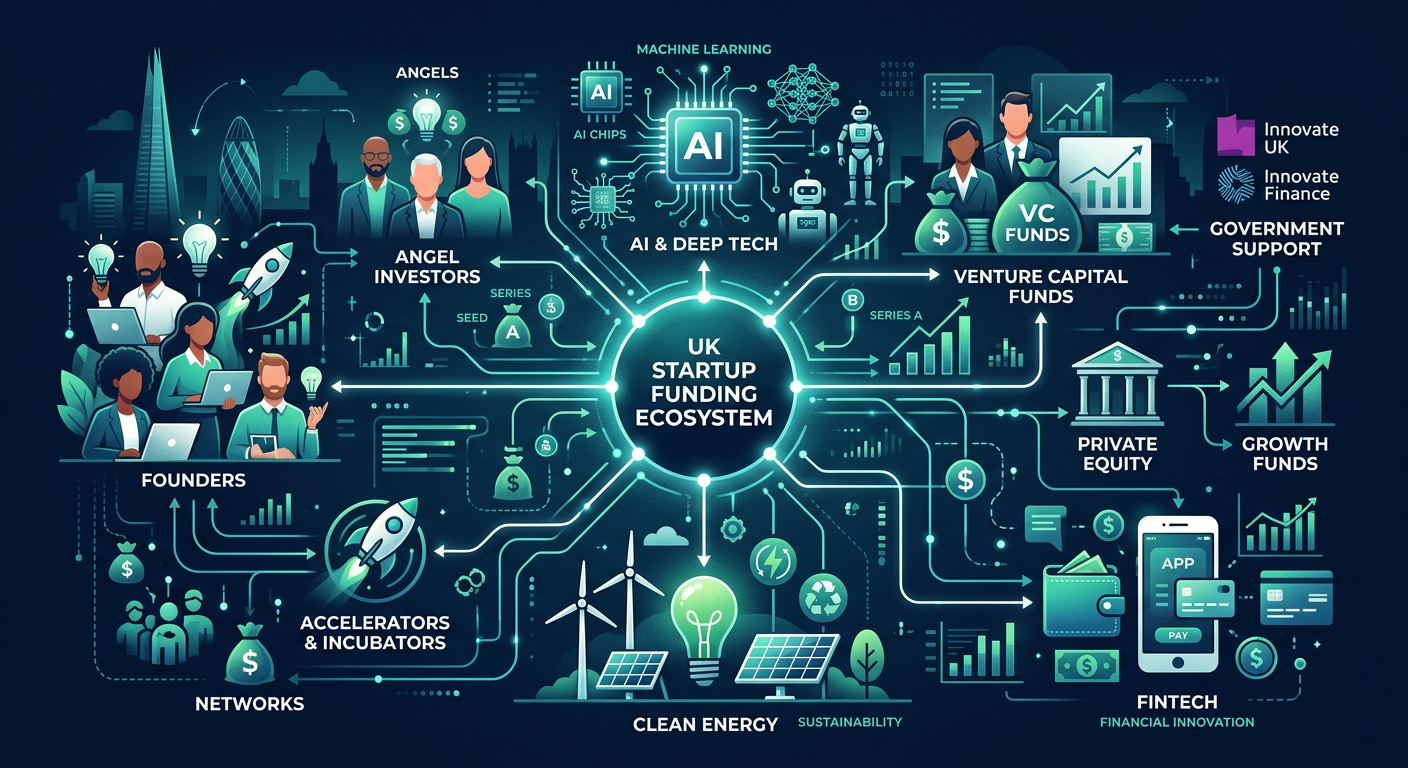
The UK still matters as one of Europe’s most important startup hubs, but the market is evolving fast. According to the British Business Bank, UK VC performance has broadly been in line with Europe and below the US, while returns have stabilized after earlier declines. The same data also shows renewed competition in the market, with company-level median valuations rising in early 2025. (british-business-bank.co.uk)

1. UK VC Is Stabilizing After The Correction
The biggest story right now is normalization. The British Business Bank reports that UK VC funds with 2002 to 2020 vintages generated a pooled TVPI of 1.84, close to the rest of Europe at 1.85, though still below the US at 1.95. It also found that returns for funds reporting in both 2024 and 2025 stayed stable, suggesting the market is no longer marking down portfolios as aggressively. (british-business-bank.co.uk)
That is important because stable pricing tends to unlock activity. When founders and investors can agree on valuations again, more deals get done. The reset has not made capital easy, but it has made the market more rational.
2. AI Is Dominating Equity Investment
One of the clearest venture capital trends in the UK is the concentration of money in AI. The British Business Bank said AI companies raised £2.9bn across 323 deals in Q1 to Q3 2025, accounting for around two-fifths of total UK equity investment. That is not a side story, it is the main event. (british-business-bank.co.uk)
For founders, the takeaway is simple, AI is attracting capital, but investors are getting more disciplined about use cases. The winners are likely to be the companies that can show productivity gains, revenue impact, or infrastructure advantage, not just a strong narrative.
3. Public Capital Is Still Crowding In Private Money
The UK market continues to rely on public institutions to help de-risk early-stage innovation. The British Business Bank’s 2025 impact reporting showed £6.8bn of finance flowing to smaller businesses in 2024/25, with support reaching 24,000 businesses and expected lifetime economic output of around £8bn. (british-business-bank.co.uk)
That support matters because it helps bridge the gap between high-potential startups and commercial VC funding. In practice, it means the UK is still using policy-backed capital to keep the pipeline moving, especially outside the most saturated parts of London.
4. Pension Capital Could Become A Bigger Force
Another important shift is the push to unlock more institutional capital. In 2026, the British Business Bank said three UK pension funds invested into UK venture capital through its Venture Link initiative, which is designed to reduce barriers and help pension funds deploy more long-term capital into UK science, technology, and innovation. (british-business-bank.co.uk)
This is a big deal because pension capital is patient capital. If that trend continues, it could increase the depth of late-stage funding and reduce the number of companies forced to look abroad too early for growth rounds.
5. Regional Funding Is Becoming More Relevant
London still dominates, but the regional story is getting stronger. The British Business Bank said 69% of lending under its Growth Guarantee Scheme went to businesses outside London and the South East, showing how support is flowing more broadly across the UK economy. (british-business-bank.co.uk)
For startups outside the capital, this matters. It means founders in cities like Bristol, Leeds, Edinburgh, Birmingham, and Manchester may find more support than they did a few years ago, especially if they are building in sectors that fit national priorities.
6. Sector Focus Is Narrowing Around Strategic Themes
Capital is following policy and productivity themes more closely than before. The British Business Bank’s strategic plan says it wants to take more risk in emerging technologies where the UK can lead globally, while also supporting businesses that start, scale, and stay in the UK. (british-business-bank.co.uk)
That makes sectors like AI, climate tech, advanced manufacturing, healthtech, fintech, and digital infrastructure especially attractive. In other words, venture capital trends in the UK are becoming more intentional and less spray-and-pray.
What Founders Should Do Now
If you are raising in the UK, the message is clear, show efficiency, not just ambition. Investors want evidence that your growth can be repeated without burning through capital at the old 2021 pace.
Focus on:
- Clear revenue quality, not vanity metrics
- A short path to product-market fit
- Strong unit economics
- A believable route to expansion or exit
- Strategic sector fit, especially in AI, fintech, and climate
Founders who can explain why their business matters now will have an easier time than those still pitching growth at any cost.
What Investors Should Watch Next
For investors, the opportunity is in the gap between strong fundamentals and market skepticism. The UK still produces ambitious companies, but pricing discipline means better entry points may now exist than during the peak funding years.
Watch for:
- Quality seed and Series A companies with efficient growth
- Regional startups with lower cost bases
- AI infrastructure and applied AI plays
- Companies aligned with public support programs
- Later-stage businesses that may become acquisition targets
The Bigger Picture For Global Readers
The UK matters beyond its borders. It remains a bridge market between the US, Europe, and increasingly global innovation ecosystems. That is why readers in Nigeria, Africa, and across the world should care about UK venture trends, they often signal where capital is moving next and which sectors are likely to shape international tech competition.
If you are a founder, investor, or operator watching global tech flows, UK venture data is not just local noise, it is an early indicator.
Conclusion
The latest venture capital trends in the UK point to a market that is maturing, not shrinking. AI is dominating funding, public capital is still playing a catalytic role, and institutional money may be starting to open up in a more meaningful way. At the same time, regional ecosystems and strategic sectors are becoming more important, which gives the UK market more depth than a London-only story.
For founders, the lesson is to build with discipline. For investors, it is to look for quality where the market is finally pricing risk more realistically. And for everyone watching global tech, the UK remains one of the most important places to understand where startup capital is heading next.
Stay Ahead Of Global Tech Shifts
TechCity covers the startup funding stories, market shifts, and innovation trends shaping technology from London to Lagos and beyond. Visit TechCity for more analysis, startup intelligence, and global tech news that helps you spot opportunities before they become obvious.