

The conversation about the impact of ai on job market is no longer theoretical. It is already changing how companies hire, how teams work, and which skills command the highest value.
That does not mean every job is disappearing. It means the labor market is being reorganized, fast. Some roles are shrinking, many are being reshaped, and entirely new ones are opening up for people who know how to work alongside AI instead of competing with it.
What AI Is Actually Changing
AI is best at speeding up repeatable tasks, spotting patterns, and handling large volumes of information. That makes it useful in customer support, data entry, marketing, content workflows, scheduling, basic analysis, and parts of software development.
For workers, the biggest shift is not total replacement, it is task replacement. A single job title may survive, but the daily work inside that role can change dramatically.
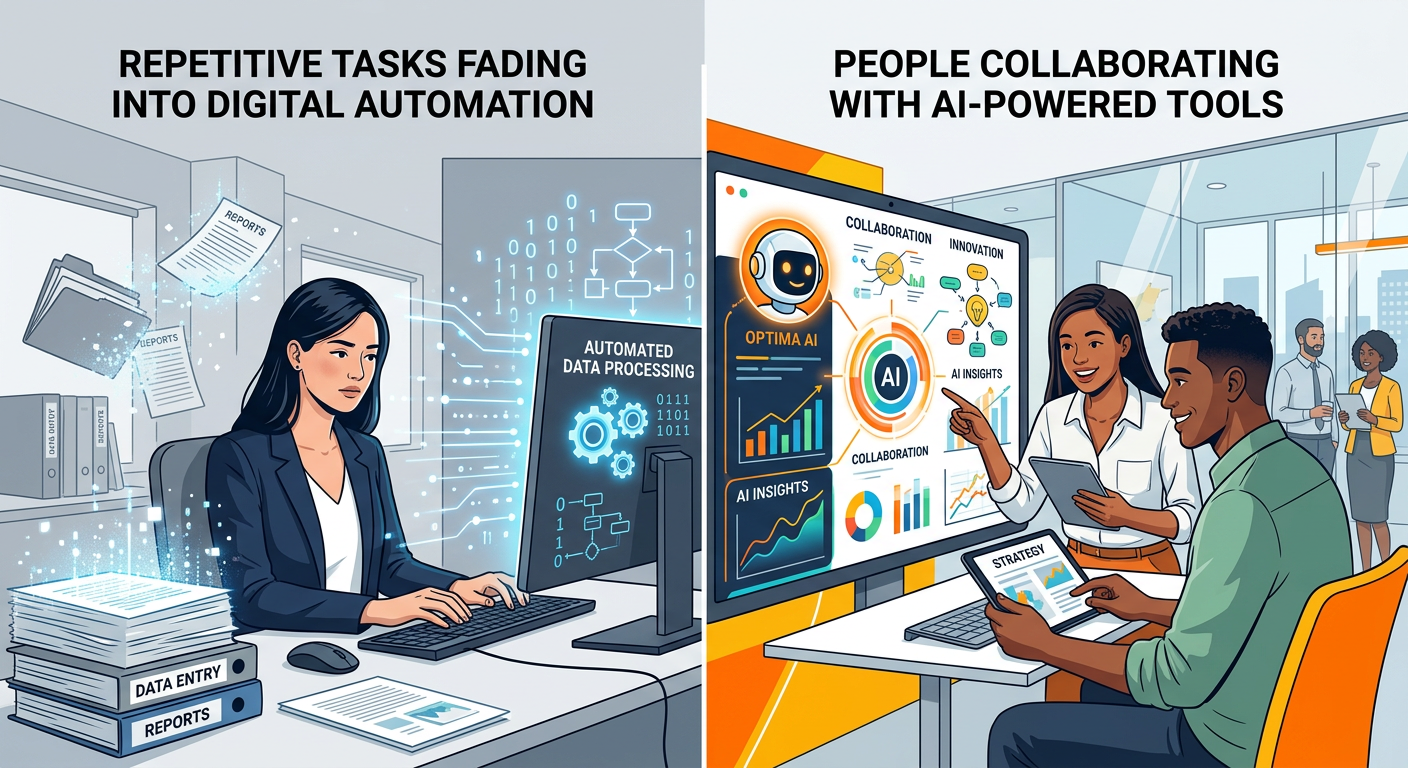

Jobs Most Affected by AI
Routine administrative work
Roles built around scheduling, document processing, transcription, and basic reporting are among the most exposed. These tasks are easy for AI systems to accelerate, which can reduce the number of people needed for the same output.
Entry-level knowledge work
AI is increasingly handling first drafts, research summaries, spreadsheet cleanup, and standard presentations. That does not eliminate junior roles, but it does raise the bar for what entry-level workers must bring to the table.
Customer service and support
Chatbots and virtual assistants now handle a growing share of common questions. Human agents are still needed for complex, emotional, or high-stakes cases, but the volume of simple tickets is falling.
Creative and marketing roles
This is where things get nuanced. AI can generate copy, images, and campaign ideas, but strategy, brand judgment, and cultural awareness still matter. The marketers who win will be the ones who use AI to move faster, not those who ignore it.
The Roles AI Is Creating
AI does not just remove work, it also creates it. Businesses now need people who can train models, audit outputs, manage AI workflows, write prompts, govern data, and keep systems aligned with business goals.
You are also seeing more demand for people who can connect technical tools to real-world outcomes. That includes AI product managers, automation specialists, AI compliance professionals, and workflow designers.
The World Economic Forum has repeatedly noted that technology adoption will both displace and create jobs over the coming years, with skills adaptation being the main factor in who benefits most. For broader context, see the World Economic Forum and International Labour Organization.
What This Means For Workers
The smartest response is not fear, it is adaptation. If your work contains repetitive steps, learn how to automate them. If your role depends on information processing, get better at asking sharper questions and making better decisions.
Here are the skills gaining value:
- AI tool fluency
- Data literacy
- Critical thinking
- Prompting and workflow design
- Communication and problem solving
- Domain expertise combined with tech comfort
In other words, the future favors people who can combine human judgment with machine speed.
What This Means For Employers
Companies that adopt AI well can do more with less friction, but the best results come from redesigning work, not just buying software. Leaders need to think about reskilling, process changes, and how to measure productivity without burning out teams.
That matters especially for SMEs and startups across Nigeria, Africa, the UK, and the US, where small teams often need leverage more than headcount. AI can provide that leverage, but only if businesses train people to use it well.
Why The Job Market Won't Change Evenly
The impact of ai on job market will vary by country, industry, and company size. Advanced economies may automate faster, while emerging markets may see slower adoption but stronger pressure to leapfrog into AI-enabled work.
That creates both risk and opportunity. Regions that invest in digital skills, broadband access, and practical AI education can move up the value chain. Those that do not may see more work concentrated in a smaller number of highly skilled roles.
How To Stay Competitive
For professionals
Start using AI in your daily workflow now. Even simple use cases, like drafting emails, summarizing meetings, or analyzing data faster, can build confidence and efficiency.
For job seekers
Tailor your CV toward outcomes, not just tasks. Show that you can use modern tools, learn quickly, and improve processes.
For businesses
Invest in training before pressure hits. The companies that prepare their teams early will adapt with less disruption and stronger retention.
The Bottom Line
The impact of ai on job market is not a single story of destruction or utopia. It is a transition, and transitions reward people who move early.
Jobs will not vanish overnight, but they will keep changing. The winners will be workers and businesses that treat AI as a practical advantage, not a distant threat.
Keep Learning With TechCity
If you want more grounded coverage of how AI, fintech, startups, and digital work are reshaping global markets, keep following TechCity. We connect the dots between Silicon Valley, Lagos, London, New York, and Nairobi so you can make smarter decisions faster.
Visit TechCity for more tech news, analysis, and practical guides.

Conclusion
AI is changing the labor market by shifting which tasks matter most, which skills are valuable, and which workers can scale their impact. That creates pressure, but it also creates a huge opening for anyone willing to learn.
The next wave of career growth will not belong only to people with the most experience. It will belong to people who can adapt fastest, think clearly, and use AI to amplify what they already do well.